A while ago the party made a vote to determine the direction of the campaign. Originally it was going to be a magic macguffin quest to stop a planet sized robot bent on destroying the galaxy, something simple and familiar. But they were so enamored with Hypercorporations that I gave out the option to instead have more social conflicts involving them and they voted in that direction's favor. To make this work out I decided to put a little structure into the campaign. They will go on a long-winded delivery quest before getting the opportunity to gain their own ship and dealing directly with hypercorporations. The bigger reason for the delivery quest is for them to meet NPCs. When they get an opportunity to actually run a ship they will also have an opportunity to recruit these NPCs as their crew or take action against them as enemies. To that end I needed a system of friendship to determine who they recruit and who they make enemies of. The system I landed on is an amalgam of the Relationship system in Ultimate Campaign, the Influence system from Ultimate Intrigue and the group Leadership system from Everyman Games' 'Ultimate Charisma'.
As a group and as an individual the PCs have a list of groups and individuals that they have relationships with. The relationship is defined by starting attitudes and move according to different actions taken towards them. For an individual you can declare that you want to start a relationship with that NPC followed by a social skill check that influences their starting attitude and also grants a relationship score equal to your Charisma Modifier (minimum 0) With favors (positive actions like gifts, quests, dates, ect) or slights(Negative actions such as attacks, theft and so on) you can increase your influence on that character. Unlike normal Relationship rules, this does not go into the negatives but favors and slights also affect starting attitudes, so if you have a high relationship score with a character that moves from Friendly to Unfriendly the numbers are just as high but the reaction is negative rather than positive. Basically betrayal and redemption is pretty powerful. To develop a relationship you can interact with favors or slights to increase the relationship score to a limit of your level plus your Charisma Modifier. Favors and slights will also change starting attitudes but keep in mind that ignoring them, doing a favor for someone they do not like or making a slight against something that they do like can affect starting attitude as well.
Relationship scores come in tiers that have numerical bonuses.
0 is an acquaintance that doesn't really know or have a greater reason to trust/abhore you.
1-5 represents an Association.
6-11 is a Friendship if their starting attitude is on the positive side of Indifference and Competition on the negative side.
12-30 represents Fellowship/Rivalry.
31 and up represents Devotion/Enmity.
These tiers are grant bonuses or penalties on various rolls equal to their tiers, so 0=0,1-5=2, 6-11=2, 12-30=3, and 31 and up = 4. For example a diplomacy roll against a character with a friendship that is Helpful would have a +2 bonus but this would be a -2 bonus if that same character was Hostile instead of Helpful. So the relationship score is levels of familiarity whereas attitude is the degree of cooperation.
This does not mean that relationship scores don't go down. Anything that causes distance will lower relationship scores like ignoring the NPC or doing something out of character. As such there is an added mechanic 'bond' which represents the principle the relationship is based on and the nature of it. There's no real list for what kind of bonds there can be and they are less mechanically relevant than alignment, but an example can be a bond is Family. You have a familial relationship and hurting other family members or not supporting family can lower relationship scores as they try to distance themselves from you. However the score doesn't lower and rather their attitude changes if you affect them directly with slights like attacking them.
Similar things happen towards groups and organizations only on a much bigger scale and has functions similar to reputation within the organization. Also, while starting relationships is voluntary with individuals any slight or favor towards an organization automatically starts one. To this end most organization relationships will be tracked by the GM.
Additionally collectively or individually PCs can form a special group called a 'crew'. Individually a player can lead a crew of NPCs who's HD is equal to the player's level plus his or her charisma modifier(Max individual HD is level-4). In order to recruit an NPC their relationship with the leader must be higher than their Psych DC (HD+Wis or Sense Motive Bonus). The crew member must also have an attitude of Indifferent, Friendly or Helpful at recruitment. The party can form a crew pooling the HD limit. This forms any sort of ship crew, guild, company and so on. Since this somewhat makes relationships similar to Leadership a lot of the same numbers apply. Things that affect Leadership scores can change attitudes and relationship scores, usually forming slights and favors. Also cohort feats were banned at the beginning of the game so that this system could replace it.
I've already given players a rundown of getting relationship points with NPCs with them keeping track through a friends and foes sheet from Dyslexic Studeo's character sheets but it is next week that I'll be revealing the full scope of it and why it will be important to make friends now so that they will have a better crew for later when they have their own ship.
And there you have it. Quick and dirty relationship rules for building a crew. I'll be using the same system in future campaigns where the campaign goal is to build kingdoms, gain allegiances or build a pirate crew. As i tinker around with it more I'll slowly introduce modifications using Everyman Game's Ultimate Charisma. For examle, the relationship tier will serve as a bonus rounds of the Antagonized condition and I'll connect it more to reputation.
Showing posts with label Infinity Matrix. Show all posts
Showing posts with label Infinity Matrix. Show all posts
Friday, August 12, 2016

Thursday, March 31, 2016
Infinity Matrix: Skills
As part of my houserules for Infinity Matrix I decided to go a different direction with skills. My general intention was to make things a bit simpler and give a bit of an edge to some of the classes that don't have many skill ranks to work with. The last part was extremely crucial due to the nature of the campaign. In a medieval-stasis setting its perfectly fine to live and die by the sword and rely on your friends to carry certain skills around. But in a futuristic setting skills are a lot more crucial because this is the kind of setting where swords and sorcery can't really solve every problem, especially in a space ship.
For this I enlisted the help of Pathfinder Unchained and built up around the consolidated skill list. In the end this is what I have. This does several things.
This does several things. First of all this takes Int out of the equation when it comes to skill ranks. This seems like a big step but it ended up making more sense to me in the environment of consolidated skills. For one you aren't penalized for having lower Int, or at least not as penalized as the game normally does. It also simplifies matters. The best part is that skill prowess starts to fall into where I think classes should be. A class with 2 ranks per level and no reason to invest in Int doesn't end up getting crippled in the skill department, something I don't want happening in the setting. They can max what is effectively 3-8 skills. Classes like the Rogue gain an incredible amount of skills making them more ideal as 'the skill guy' instead of other classes that have reasons to invest in Int and therefore actually capable of gaining more skills.
There are a few percieved problems that seem to appear but get alieviated naturally.
Casters of any sort that rely on Int get penalized. This isn't as bad as a problem as it sounds. A wizard can max upwards to 8 effective skills which is the same amount of skill ranks that they would get if they had 22 Int, which definitely isn't bad. The most likely skills to max in their case is Spellcraft and an Expertise which is effectively 7 skills. They certainly aren't helped if they go past 20 Int but they aren't crippled by the system.
Int becomes irrelevant because having low Int doesn't penalize. Int is less relevant here as you can still be relatively skillful without the Int investment. But while low Int doesn't penalize having it is more useful than not having it. Your amount of class skills is still effected by Int so it gives the ability to spread skill ranks around and if you have low Int you actually start having fewer class skills than you have ranks to max them out so you'll be missing that class skill boost. Also Int still controls almost half the skill list, with one of the skills being a multi-skill and some skills, like Use Magic Device and Handle Animal got folded into an Int-based skill. Int is still very potent and desirable to have, you just aren't heavily crippled from not having quite enough.
As to why I went with the consolidated skill list rather than Background Skills is simple. Simplicity. I'm already adding quite a bit to the game. I didn't desire a more complicated skill system on top of that. That and the background skill system solves very few of my problems. I didn't want to use the consolidated skill list as is because even that was more complicated. In it's original version you would get 1/2 your ranks per level plus 1/2 your Int bonus. This means that you need at least 14 Int before it matters and 18 Int before it matters more. It just puts the skill power more into the hands of classes that use Int as a casting stat rather than classes that are meant to be skillful. I was also not keen on having Craft and Knowledge Engineering left out in a Scifi adventure campaign, thus the Expertise skill. Expertise was also created to account for skill ranks pulled for other sources. With 8 ranks per level, classes like the Rogue can consume a huge amount of the list and if they can pull ranks from other sources Expertise gives a bit of room to grow into. This also lowers the impact of skill ranks from unexpected sources since Expertise can eat up a lot of skills if you try to be a super science whiz.
The rest of the changes were based on the fact that I use a lot of third party material. I didn't want to create new skill lists for each class I'd allow so I just let players pick what class skills they would get. I didn't want to change each race one by one, work that would have to happen if I used this system for another campaign so I just allow skill bonuses to apply to functions over specific skills. The same goes for skills in regards to class features. I just didn't want to sift through classes and archetypes to change everything so adjusted the consolidated skill system to account for whatever new classes pop up.
So that is my revised Consolidated Skill list which is what my players are using for the Infinity matrix campaign. Leave a comment if you have questions, praises or criticisms. If possible please try this out in your own campaigns and tell me how it worked out for you. I'd love to see more reports on how this works in action.
For this I enlisted the help of Pathfinder Unchained and built up around the consolidated skill list. In the end this is what I have. This does several things.
Rules for skills follow the Consolidated Skills rules from Pathfinder Unchained with the following changes.
Skill
|
Untrained
|
Ability
|
Skills Included
|
Acrobatics
|
Y
|
Dex
|
Acrobatics(except Jumping), Escape Artist, Fly, Ride
|
Athletics
|
Y
|
Str
|
Acrobatics(Jumping), Climb Swim
|
Expertise (Multi)
|
N
|
Int
|
Appraise, Craft, Knowledge(engineering), Profession
|
Finesse
|
N
|
Dex
|
Disable Device, Sleight of Hand
|
Influence
|
Y
|
Cha
|
Bluff, Diplomacy, Intimidate
|
Nature
|
N
|
Int
|
Handle Animal, Knowledge(dungeoneering, geography, nature)
|
Perception
|
Y
|
Wis
|
Perception, Sense Motive
|
Performance
|
Y
|
Cha
|
Disguise, Perform
|
Psionics
|
N
|
Int
|
Autohypnosis, Knowledge(psionics), Use Psionic Device
|
Religion
|
N
|
Int
|
Knowledge(planes, religion)
|
Society
|
N
|
Int
|
Knowledge(history, local, nobility), Linguistics
|
Spellcraft
|
N
|
Int
|
Knowledge(arcana), Spellcraft, Use Magic Device
|
Stealth
|
Y
|
Dex
|
Stealth
|
Survival
|
Y
|
Wis
|
Heal, Survival
|
- Classes get their full class skill ranks per level but not their bonus from INT. For example; a Fighter would get 2 ranks per level, a Monk would get 4 ranks per level and a Bard would get 6.
- To accommodate classes from third party sources you may choose your class skills. You may have up to your ranks per level plus your INT bonus in class skills chosen among any of the skills that your normal class skills folds into. For example if you would normally gain Bluff, Diplomacy or Intimidate as a class skill you may choose Influence as class skill. When you multiclass you gain two extra class skills.
- A new skill Expertise has been added. Like the old functions of Perform, Expertise is actually a number of separate skills. You could have several Expertise skills, each with its own ranks. The most common Expertise subjects are; Food, War, Mechanical, Seafaring, Alchemy, Metalworking, Apparel, Farming, and Construction. Potential subjects include; Chemestry, Biology, Electronics and Machinery. Expertise covers the old functions of Appraise, Craft, Knowledge(engineering), and Profession. You can only gain one Expertise skill as a class skill at a time like what was previously the knowledge skills.
- A new skill Psionics has been added. This skill is only applicable in the context of using psionic rules from Dreamscarred Press when psionics is ruled as different from magic.
- Racial bonuses and bonuses gained from class features apply to specific skill function not to all functions of the consolidated skill and are not halved.
- The following feats are removed from the game and any feat that would use them for prerequisites no longer require them; Acrobatic, Alertness, Animal Affinity, Athletic, Deceitful, Deft Hands, Magical Aptitude, Persuasive, Self-Sufficient, Stealthy.
- Any bonus applied to a Craft skill now applies to an Expertise instead.
This does several things. First of all this takes Int out of the equation when it comes to skill ranks. This seems like a big step but it ended up making more sense to me in the environment of consolidated skills. For one you aren't penalized for having lower Int, or at least not as penalized as the game normally does. It also simplifies matters. The best part is that skill prowess starts to fall into where I think classes should be. A class with 2 ranks per level and no reason to invest in Int doesn't end up getting crippled in the skill department, something I don't want happening in the setting. They can max what is effectively 3-8 skills. Classes like the Rogue gain an incredible amount of skills making them more ideal as 'the skill guy' instead of other classes that have reasons to invest in Int and therefore actually capable of gaining more skills.
There are a few percieved problems that seem to appear but get alieviated naturally.
Casters of any sort that rely on Int get penalized. This isn't as bad as a problem as it sounds. A wizard can max upwards to 8 effective skills which is the same amount of skill ranks that they would get if they had 22 Int, which definitely isn't bad. The most likely skills to max in their case is Spellcraft and an Expertise which is effectively 7 skills. They certainly aren't helped if they go past 20 Int but they aren't crippled by the system.
Int becomes irrelevant because having low Int doesn't penalize. Int is less relevant here as you can still be relatively skillful without the Int investment. But while low Int doesn't penalize having it is more useful than not having it. Your amount of class skills is still effected by Int so it gives the ability to spread skill ranks around and if you have low Int you actually start having fewer class skills than you have ranks to max them out so you'll be missing that class skill boost. Also Int still controls almost half the skill list, with one of the skills being a multi-skill and some skills, like Use Magic Device and Handle Animal got folded into an Int-based skill. Int is still very potent and desirable to have, you just aren't heavily crippled from not having quite enough.
As to why I went with the consolidated skill list rather than Background Skills is simple. Simplicity. I'm already adding quite a bit to the game. I didn't desire a more complicated skill system on top of that. That and the background skill system solves very few of my problems. I didn't want to use the consolidated skill list as is because even that was more complicated. In it's original version you would get 1/2 your ranks per level plus 1/2 your Int bonus. This means that you need at least 14 Int before it matters and 18 Int before it matters more. It just puts the skill power more into the hands of classes that use Int as a casting stat rather than classes that are meant to be skillful. I was also not keen on having Craft and Knowledge Engineering left out in a Scifi adventure campaign, thus the Expertise skill. Expertise was also created to account for skill ranks pulled for other sources. With 8 ranks per level, classes like the Rogue can consume a huge amount of the list and if they can pull ranks from other sources Expertise gives a bit of room to grow into. This also lowers the impact of skill ranks from unexpected sources since Expertise can eat up a lot of skills if you try to be a super science whiz.
The rest of the changes were based on the fact that I use a lot of third party material. I didn't want to create new skill lists for each class I'd allow so I just let players pick what class skills they would get. I didn't want to change each race one by one, work that would have to happen if I used this system for another campaign so I just allow skill bonuses to apply to functions over specific skills. The same goes for skills in regards to class features. I just didn't want to sift through classes and archetypes to change everything so adjusted the consolidated skill system to account for whatever new classes pop up.
So that is my revised Consolidated Skill list which is what my players are using for the Infinity matrix campaign. Leave a comment if you have questions, praises or criticisms. If possible please try this out in your own campaigns and tell me how it worked out for you. I'd love to see more reports on how this works in action.
Monday, March 21, 2016
Infinity Matrix: Character Creation.
The Infinity Matrix campaign is well under way. I'll be making updates every two weeks as we continue the campaign with some GM information in between to give an idea of how to pull it off. We just completed our session zero.
Not many of the house rules had to be clarified. I had most everything I intended written down on handouts so it was just a matter of pointing out clauses that explain what's going on. The only issues I had with rulings were with people that weren't all that familiar with the game to begin with.
Some of the players took great advantage of the house rules, particularly the technology discount and weapon sizing revision. This produced a lot of cheese such as one player taking a class that grew him two extra arms with the intent of wielding four firearms with Multiweapon Fighting. Same player is wielding small sized firearms to make them light weapons to knock 2 off the off-hand penalty, which I allowed. A number of the players have taken to cybernetic implants as well boosting some numbers. Despite all such things, one thing that was surprising is that all the incredible numbers is in their damage capabilities. AC, saves, attack bonuses and HP is actually kind of piddly which worries me a little bit as creatures with similar advantages could easily kill them just as quickly as they can be killed, effectively making a game of rocket launcher tag at level 3.
On session 1, which is in two weeks, I'll start off with a moderately high amount of CR1 and CR2 creatures to test the waters and see how much punishment they can actually take. My guess is that they'll plow through monsters like butter but have a hard time getting hit so high amounts of appropriately powerful monsters would work out best. Luckily I have some time to sort out humanoid creatures that have the same advantages that they do because that could easily kill them.With monsters I can just modify them up to adjust to whatever's going on. I start off with a base of what's appropriate for their levels and then templates versions in case they start dying before they can do anything. The templates from the Advanced Bestiary help out a lot in this.
From my last post I eventually decided to add a weapon training feat to the game. This was popular for anyone that wanted to use a firearm but it did reveal one issue with firearms in general which was that it was a very feat intensive fighting style. This makes me less worried about too much damage coming from firearms because anyone that gets out a cheezy amount of damage out of it has to pay the feat price but no one is so hard hit by it that anyone is avoiding firearms.
As anticipated Fantastic Technology from Fat Goblin Games was a BIG hit at character creation. I wanted to use more dynamic monsters and equip the players with actual technology at level 3 despite technology being super expensive so I implemented this house rule:
Not many of the house rules had to be clarified. I had most everything I intended written down on handouts so it was just a matter of pointing out clauses that explain what's going on. The only issues I had with rulings were with people that weren't all that familiar with the game to begin with.
Some of the players took great advantage of the house rules, particularly the technology discount and weapon sizing revision. This produced a lot of cheese such as one player taking a class that grew him two extra arms with the intent of wielding four firearms with Multiweapon Fighting. Same player is wielding small sized firearms to make them light weapons to knock 2 off the off-hand penalty, which I allowed. A number of the players have taken to cybernetic implants as well boosting some numbers. Despite all such things, one thing that was surprising is that all the incredible numbers is in their damage capabilities. AC, saves, attack bonuses and HP is actually kind of piddly which worries me a little bit as creatures with similar advantages could easily kill them just as quickly as they can be killed, effectively making a game of rocket launcher tag at level 3.
On session 1, which is in two weeks, I'll start off with a moderately high amount of CR1 and CR2 creatures to test the waters and see how much punishment they can actually take. My guess is that they'll plow through monsters like butter but have a hard time getting hit so high amounts of appropriately powerful monsters would work out best. Luckily I have some time to sort out humanoid creatures that have the same advantages that they do because that could easily kill them.With monsters I can just modify them up to adjust to whatever's going on. I start off with a base of what's appropriate for their levels and then templates versions in case they start dying before they can do anything. The templates from the Advanced Bestiary help out a lot in this.
From my last post I eventually decided to add a weapon training feat to the game. This was popular for anyone that wanted to use a firearm but it did reveal one issue with firearms in general which was that it was a very feat intensive fighting style. This makes me less worried about too much damage coming from firearms because anyone that gets out a cheezy amount of damage out of it has to pay the feat price but no one is so hard hit by it that anyone is avoiding firearms.
As anticipated Fantastic Technology from Fat Goblin Games was a BIG hit at character creation. I wanted to use more dynamic monsters and equip the players with actual technology at level 3 despite technology being super expensive so I implemented this house rule:
For the purposes of character creation technological equipment is 10% of it’s normal cost and psionic and alchemical items are 50% their normal cost. This cost reduction is applied after changes such as masterwork, enchantment and material. Items technologically modified or made of skymetals, nanoweve, or plastic are considered technological. After buying equipment each character has 100 gp remaining regardless of how much of the 5000 gp was spent.
Plastic was from Fantastic Technology and effectively is mithril that doesn't adjust the armor category and actually makes the armor cheaper, so rather than make adjustments from Anachronistic Adventures this just made armor better and cheaper by material conversion. It also made melee combat actually possible with a higher variety of weapons which was big for everyone. The technological modifications allowed players to dip deeper into the technological while still having a foot in comfortable and familiar territory. Basically, big shout out to Fat Goblin Games.
As for other things that were popular; I'll have the full build breakdowns in two weeks as the finalized characters trickle in but I have one class from It Came from the Stars (Starseed), two psionic classes (Soulknife and Psychic Warrior), two from Anachronistic Adventures, (Enforcer and Cogiator), and one from Classes of NeoExodus (The Host).
Starting two weeks from now I'll try to make a report on each session to give details about how I'm running the campaign, but in the meantime I'll post some more about the world and the campaign including maps and plot lines.
Friday, March 18, 2016
Infinity Matrix: The Gunslinger
As the session zero date for the Infinity Matrix campaign comes up there's one more gun related thing I have to tackle, and for this I'm going to ask the players what they want before they make their characters.
The Gunslinger is a very controversial class, usually just for bringing guns into the equation but also it can deal a lot of damage in a short amount of time if cheesed out. Usually the limitations of firearms knock it down a pet as using Rapid Shot with two guns can easily equal a -8 penalty to each shot and a boatload of gold lost. The limitations are lessened in a futuristic setting naturally but there's one problematic ability, which is Gun Training, a means to add dexterity to damage rolls with firearms.
This is a problem for a few reasons. Dex to damage makes firearms way more dangerous but that's easy to compensate for so the biggest problem is that the gunslinger is the only one that can do it. With guns being martial weapons in this campaign it's easy enough to use them but that dex to damage is way too valuable to pass up forcing anyone that would want to do this to dip into gunslinger since everyone would want to use a firearm and I don't want Gunslinger to be the only class that does this if everyone is using firearms.
Luckily this can be easy to house rule away but there are a few ways to go about it that are pretty good so I'm giving my players a choice.
1. Ban Gunslinger. This eliminates the problem altogether and I don't have to change anything. Although despite the advantages of firearms using rapid shot with them and using automatic mode is still -4 to each shot so they may actually come out relatively weak considering that technology makes melee combat pretty dangerous and the ability to avoid touch attacks is greatly increased. Also this option makes energy resistance extra annoying and thus eventually Clustered Shot a feat tax just to deal damage to anyone in a HEV suit.
2. Change how firearms work. One thing that I do for steampunky games is to make firearms lose the touch attacks and misfire and instead naturally deal dex to damage. Gunslinger gets Gun Training but its a +1 competence bonus at first level and every four levels after. This still results in me not needing to do anything to compensate for touch attacks being a major thing. However this makes some abilities and items useless like bulletproofing, scatterlight armor and the Avoidance feat chain.
3. Make Gun Training a combat feat, prerequisite +1 BAB and 13 Dex. This is the most extreme in terms of compensating but it's not impossible. In situations like this I add creatures' Natural Armor to their touch AC against firearms or as DR through the use of third party templates. Or in some cases just adding more monsters. It also can prove to be pretty lethal to players as They have to account for NPCs with firearms dealing a lot of damage to them without bonus HP to compensate. This makes touch AC very vital and although there is enough defenses to go around this will eat up equipment, feats or class features.
The Gunslinger is a very controversial class, usually just for bringing guns into the equation but also it can deal a lot of damage in a short amount of time if cheesed out. Usually the limitations of firearms knock it down a pet as using Rapid Shot with two guns can easily equal a -8 penalty to each shot and a boatload of gold lost. The limitations are lessened in a futuristic setting naturally but there's one problematic ability, which is Gun Training, a means to add dexterity to damage rolls with firearms.
This is a problem for a few reasons. Dex to damage makes firearms way more dangerous but that's easy to compensate for so the biggest problem is that the gunslinger is the only one that can do it. With guns being martial weapons in this campaign it's easy enough to use them but that dex to damage is way too valuable to pass up forcing anyone that would want to do this to dip into gunslinger since everyone would want to use a firearm and I don't want Gunslinger to be the only class that does this if everyone is using firearms.
Luckily this can be easy to house rule away but there are a few ways to go about it that are pretty good so I'm giving my players a choice.
1. Ban Gunslinger. This eliminates the problem altogether and I don't have to change anything. Although despite the advantages of firearms using rapid shot with them and using automatic mode is still -4 to each shot so they may actually come out relatively weak considering that technology makes melee combat pretty dangerous and the ability to avoid touch attacks is greatly increased. Also this option makes energy resistance extra annoying and thus eventually Clustered Shot a feat tax just to deal damage to anyone in a HEV suit.
2. Change how firearms work. One thing that I do for steampunky games is to make firearms lose the touch attacks and misfire and instead naturally deal dex to damage. Gunslinger gets Gun Training but its a +1 competence bonus at first level and every four levels after. This still results in me not needing to do anything to compensate for touch attacks being a major thing. However this makes some abilities and items useless like bulletproofing, scatterlight armor and the Avoidance feat chain.
3. Make Gun Training a combat feat, prerequisite +1 BAB and 13 Dex. This is the most extreme in terms of compensating but it's not impossible. In situations like this I add creatures' Natural Armor to their touch AC against firearms or as DR through the use of third party templates. Or in some cases just adding more monsters. It also can prove to be pretty lethal to players as They have to account for NPCs with firearms dealing a lot of damage to them without bonus HP to compensate. This makes touch AC very vital and although there is enough defenses to go around this will eat up equipment, feats or class features.
Tuesday, March 15, 2016
Infinity Matrix: He's got a gun! Extra!
A while ago I made a post talking about my decision to leave everything alone when it comes to firearm rules in a scifi setting and realized I had a few extra things to say. Realistically in a world with high tech guns it makes sense that the game becomes a gunfest, and by extension a game of 'Go Dex or go home.', but where's the romance and the flavor in that? I wanted to make sure that Strength had something that at least looked viable which means melee options had to exist. Luckily after doing the math, I still don't have to change much.
Currently Treasury of the Machine from Legendary Games has the best ballistic firearms which have a really convenient option of having a strength rating, much like composite longbows in the form of recoil. So if you want a big gun that deals more damage you need more strength and it keeps ballistic firearms unique and still on the table, and like the energy damage futuristic firearms there are plenty of defenses for it even if you aren't focusing on dexterity for touch AC.
But what about being hard hitting with melee damage? Damage kinds of catches up. The addition of third party material there are a lot more options to increase damage with powered weapons but it's the Technology guide that gives the real doozy. The Gravity Chip have weapons deal damage as if it were one size category larger and is surprisingly cheap. Imagine that with the vital strike chain. A normal earthbreaker ends up 8d6, but with a Gravity Clip it ends up 12d6. Add to that third party feats that allow you to wield oversized weapons anyways so if you try to replicate Cloud Strife from Final fantasy with a Gravity Clip your vital strikes can end at 16d6. Past that there's the existence of a few technological weapons that do an absurd amount of damage and sometimes hit on touch attacks. If a large earthbreaker with a gravity clip is scary a chainsaw using the same strategy ends at 24d6. A monowhip has reach and hits touch AC while being possible to go with Two Weapon Fighting. Late game easily becomes a nightmare of numbers when it comes to melee combat so I'm less concerned about melee combat surviving, but whether or not HP can keep up.
There is a bit of rock-paper-scissors going on. If you focus on touch AC and resist energy weapons you'll get hit harder with ballistic firearms and hard melee weapons. If you focus on resisting ballistic firearms, energy weapons will get you and bulletproofing doesn't defend well from hard melee weapons. If you focus on resisting melee weapons then you'll get hit by touch attacks. About the only way to deal with everything at once without dying too fast is force fields or taking advantage of the environment. Anticipating force fields as a hot commodity I'm giving away a few for free in the first dungeon of Infinity Matrix to see how things go.
All that said some aspects of dealing with technological weapons is somewhat of an experiment. I can theorycraft and test play all I want but really having players means tat the ability to deal with the power creep can lean towards one way or the other so I'll have to see what gets built. I am warning them a bit. I let them know that standing in the middle of a room with a lot of enemies with guns is generally bad. So is going through corridors in their usual konga line is pretty bad too. Also that they should use cover against firearms and where to find defenses for everything.
Currently Treasury of the Machine from Legendary Games has the best ballistic firearms which have a really convenient option of having a strength rating, much like composite longbows in the form of recoil. So if you want a big gun that deals more damage you need more strength and it keeps ballistic firearms unique and still on the table, and like the energy damage futuristic firearms there are plenty of defenses for it even if you aren't focusing on dexterity for touch AC.
But what about being hard hitting with melee damage? Damage kinds of catches up. The addition of third party material there are a lot more options to increase damage with powered weapons but it's the Technology guide that gives the real doozy. The Gravity Chip have weapons deal damage as if it were one size category larger and is surprisingly cheap. Imagine that with the vital strike chain. A normal earthbreaker ends up 8d6, but with a Gravity Clip it ends up 12d6. Add to that third party feats that allow you to wield oversized weapons anyways so if you try to replicate Cloud Strife from Final fantasy with a Gravity Clip your vital strikes can end at 16d6. Past that there's the existence of a few technological weapons that do an absurd amount of damage and sometimes hit on touch attacks. If a large earthbreaker with a gravity clip is scary a chainsaw using the same strategy ends at 24d6. A monowhip has reach and hits touch AC while being possible to go with Two Weapon Fighting. Late game easily becomes a nightmare of numbers when it comes to melee combat so I'm less concerned about melee combat surviving, but whether or not HP can keep up.
There is a bit of rock-paper-scissors going on. If you focus on touch AC and resist energy weapons you'll get hit harder with ballistic firearms and hard melee weapons. If you focus on resisting ballistic firearms, energy weapons will get you and bulletproofing doesn't defend well from hard melee weapons. If you focus on resisting melee weapons then you'll get hit by touch attacks. About the only way to deal with everything at once without dying too fast is force fields or taking advantage of the environment. Anticipating force fields as a hot commodity I'm giving away a few for free in the first dungeon of Infinity Matrix to see how things go.
All that said some aspects of dealing with technological weapons is somewhat of an experiment. I can theorycraft and test play all I want but really having players means tat the ability to deal with the power creep can lean towards one way or the other so I'll have to see what gets built. I am warning them a bit. I let them know that standing in the middle of a room with a lot of enemies with guns is generally bad. So is going through corridors in their usual konga line is pretty bad too. Also that they should use cover against firearms and where to find defenses for everything.
Thursday, February 11, 2016
Infinity Matrix: He's got a gun!
I've had to think long and hard about how guns are going to work in a space based campaign.
In Pathfinder firearms are notoriously problematic. On their own they aren't very remarkable. In close range they hit touch AC but the ammunition is expensive, they have a built in critical fumble mechanic, and they have a reload time. With a gunslinger and/or the right feats something good can come out of it but it's much simpler to just use a longbow. With advanced firearms the gunslinger's ability to deal dexterity to damage becomes more relevant as you can more easily continuously shoot and if you make firearms more prevalent in the world the price goes down dramatically. The issue with touch attacks becomes more pronounced as players can easily wipe out creatures in one round as the price goes down and guns become more useable. Technological firearms are potentially worse as they have effectively 10 round clips, ammunition price that becomes negligible in a scifi setting, no misfire, free stacking Rapid Shot, and all attack touch AC. So what do I do?
I experimented with a lot of scenarios taking rules from various scifi Pathfinder books. At some point the best option looked like changing a few Gunslinger class features in order to remove touch attacks from all firearms and instead allow them to add dexterity to damage rolls. But in the end I decided to do nothing for the most part, and here is why;
Firstly, with third party products involved there are a lot of defenses against firearms. In Paizo's Technology Guide Scatterlight armor has AC that counts as touch AC against beam weapons and armor that grants resistance from energy damage. In Fat Goblin Game's Fantastic Technology there are armor modifications that counts AC against firearms. In Rogue Genius Games' Anachronistic Adventures there are a series of feats that grant more and more dodge bonuses. Within the base game there are plenty of additional ways to get more touch AC including taking cover. Through feats, items or tactics the campaign has enough material to avoid dying from gun fights at the drop of a hat so from their end the issue of firearms hitting touch AC is diminished.
Secondly, monsters are still easier to kill and I'm okay with that. While NPCs can enjoy the benefits of armor and feats that keep them from dying too fast to firearms, (especially technological ones that have way fewer drawbacks.) what about monsters or pre-printed NPCs? Well from a flavor standpoint I don't care if monsters and NPCs die easily. The PCs are heroes, the main characters of the story, but mechanically they have to go through a lot of enemies that have full HP. In this campaign I decided that it's okay because I can more easily make PCs feel threatened but also feel like invincible heroes from movies like Rambo or Total Recall by mowing down monsters by the dozens. This also appeals to when I want to be lazy by using premade stat blocks over building a monster or NPC while making PCs feel like action heroes.
Eventually it is a combination of third party fixing problems themselves and not wanting to shake up the game more than I already have.
In Pathfinder firearms are notoriously problematic. On their own they aren't very remarkable. In close range they hit touch AC but the ammunition is expensive, they have a built in critical fumble mechanic, and they have a reload time. With a gunslinger and/or the right feats something good can come out of it but it's much simpler to just use a longbow. With advanced firearms the gunslinger's ability to deal dexterity to damage becomes more relevant as you can more easily continuously shoot and if you make firearms more prevalent in the world the price goes down dramatically. The issue with touch attacks becomes more pronounced as players can easily wipe out creatures in one round as the price goes down and guns become more useable. Technological firearms are potentially worse as they have effectively 10 round clips, ammunition price that becomes negligible in a scifi setting, no misfire, free stacking Rapid Shot, and all attack touch AC. So what do I do?
I experimented with a lot of scenarios taking rules from various scifi Pathfinder books. At some point the best option looked like changing a few Gunslinger class features in order to remove touch attacks from all firearms and instead allow them to add dexterity to damage rolls. But in the end I decided to do nothing for the most part, and here is why;
Firstly, with third party products involved there are a lot of defenses against firearms. In Paizo's Technology Guide Scatterlight armor has AC that counts as touch AC against beam weapons and armor that grants resistance from energy damage. In Fat Goblin Game's Fantastic Technology there are armor modifications that counts AC against firearms. In Rogue Genius Games' Anachronistic Adventures there are a series of feats that grant more and more dodge bonuses. Within the base game there are plenty of additional ways to get more touch AC including taking cover. Through feats, items or tactics the campaign has enough material to avoid dying from gun fights at the drop of a hat so from their end the issue of firearms hitting touch AC is diminished.
Secondly, monsters are still easier to kill and I'm okay with that. While NPCs can enjoy the benefits of armor and feats that keep them from dying too fast to firearms, (especially technological ones that have way fewer drawbacks.) what about monsters or pre-printed NPCs? Well from a flavor standpoint I don't care if monsters and NPCs die easily. The PCs are heroes, the main characters of the story, but mechanically they have to go through a lot of enemies that have full HP. In this campaign I decided that it's okay because I can more easily make PCs feel threatened but also feel like invincible heroes from movies like Rambo or Total Recall by mowing down monsters by the dozens. This also appeals to when I want to be lazy by using premade stat blocks over building a monster or NPC while making PCs feel like action heroes.
Eventually it is a combination of third party fixing problems themselves and not wanting to shake up the game more than I already have.
Saturday, January 16, 2016
Infinity Matrix: Races
I slowed down a bit on the posts due to a lot of things going on right now. My wife and I were sick during Christmas time and my sister's Christmas plans fell through so I had a lot of catching up to do including last night's trip to finally see Star Wars: The Force Awakens. Long story short: I loved it and it has reignited my anticipation for the Infinity Matrix campaign as well as the upcoming release of Aethera. For those not in the know, Aethera was a kickstarter from late last year for a space opera campaign setting for Pathfinder. The goal was $50,000 which I thought was impossible, especially since halfway through there were nowhere near their goal but it pulled it off with two grand more than the goal proving that I'm not the only fan of throwing Pathfinder into outer space. As far as I can tell it's looking at having an April release, which is pretty quick considering that other Pathfinder kickstarters I've backed or followed.
I'm also keeping an eye on Alterkine, a project that is probably the space based race book I've been needing. I haven't fully decided whether or not to back it as I don't know the company and I probably have enough races for Infinity Matrix. If you have any info that will entice me before the kickstarter is over give me a post but here is what I've been doing so far with races:
Paizo Races: Humans, Androids, Kasathas, Lashuntas, Triaxians
Humans are a given but People of the Stars puts most of what I need into a neat book that I can hand to players so they're in and Trox and the new 'blank face' race from Bestiary 5 are out. As Paizo races they have a bit of support from People of the Stars and Book of Heroic Races handles a bit more for Androids, which is good because while the other races are interesting Androids are the most important because they cover a very basic trope. Kasathas are mechanically the msot interesting because of the whole four arms dynamic. It opens up new questions and is a weird quirk that distinguishes it as a race worth playing.
It Came from the Stars: Amoebians, Enlightened, Star Touched, Tachiods
One of the more interesting groupings, You have something quirky and alien with the Amoebians, being giant amoebas-like creatures, something that I really needed to throw in there because otherwise I may as well pallet swap elves and dwarves and stuff for aliens. Then I'd just be swarming the game with bumpy forehead aliens. Lame. The Star Touched aren't that strange but they are close to my heart because they remind me of the comic character Starfire and have the mechanics to back it up. The rest kind of amp tropes that I already have to a more interesting degree. It Came from the Stars is already an important toolbox for playing in space but the races are incredible. I decided not to touch Coalecents though, mostly because they are more past the norm than I'd like for this game.
Legendary Planet Races: Auttaine, Chlorvian, Tretharri, Zvarr
Legendary Planet's Player's Guide is a nice book for space based games that don't involve the Legendary Planet adventure. The four new races are pretty nice. Given what I already have the Chlorvian, plant people, are the only ones that satisfy my trope grid filling instincts although the Zvarr, a more monstrous lizardy race, gives a bit more pizzaz. Mechanically the Auttaine are the most interesting with a racial trait that's basically floating race points that can be spent in a limited way.
Veil of Truth: Celonian, En, Karizar, Nabora, Niterian, Thoy'ykoth, Yahidar
I didn't like Veil of Truth. My reasons why will come up when I review it this month, But the book is well worth the price just for the set of races. To some extent a lot of them aren't terribly interesting beyond their looks but the looks are great and cover a lot of ground. Plus a few of the mechanics are very interesting. They are somewhat filler races but they are great filler races that evoked a lot of imagination from me. Plus the Celonians are my pick for Grey Alien racial stats, although I had to modify their Naturally Psychic racial trait to Naturally Psionic.
Age of Electrotech: Mutamorphs, Nashi
So these aren't exactly aliens but I felt the need for a 'variable' race and it covers transhuman grounds in a neat way. Plus I'm a big fan of Batman Beyond an I was able to confirm that the Mutamorphs were inspired by the Splicers of that show. Basically Mutamorphs are animal DNA splicing transhumans. The Nashi, raccoon race, will immediately be the 'Rocket Racoon race' but they're mostly there because the Mutamorphs are there.
Ultimate Psionics Races: Dromite, Elan, Maenad, Noral, Ophiduan, Xeph
I decided to stray from the psionic races that I felt too steeped in fantasy tropes so races like Duergar and Half-Giants were out, leaving what's still a pretty interesting and well supported set of races that are alien enough to be aliens.
So there you have it. 27 races for a Galaxy. Some things didn't make the cut. The Race creator from the Santiago Player Guide I may use but with 27 races things are pretty crowded. I don't have Aethera races yet. The race creator from Infinite Futures 2.0 would be useful but I threw the baby out with the bathwater but not wanting any other player information from Infinite Futures. From the previous edition of Infinite Futures there is a series of racial books that I have, that I don't like for missing crucial information for them to function and has a bunch of added information that I really don't want to deal with. The Reptoids from Bestiary 5 are in the setting but are way too malevolent for me to hand off to players in this campaign and instead I list Ophiduans as appropriate offshoots of the race that's less about covertly conquering planets.
If you have or know of any other good alien races give me a comment.
I'm also keeping an eye on Alterkine, a project that is probably the space based race book I've been needing. I haven't fully decided whether or not to back it as I don't know the company and I probably have enough races for Infinity Matrix. If you have any info that will entice me before the kickstarter is over give me a post but here is what I've been doing so far with races:
Paizo Races: Humans, Androids, Kasathas, Lashuntas, Triaxians
Humans are a given but People of the Stars puts most of what I need into a neat book that I can hand to players so they're in and Trox and the new 'blank face' race from Bestiary 5 are out. As Paizo races they have a bit of support from People of the Stars and Book of Heroic Races handles a bit more for Androids, which is good because while the other races are interesting Androids are the most important because they cover a very basic trope. Kasathas are mechanically the msot interesting because of the whole four arms dynamic. It opens up new questions and is a weird quirk that distinguishes it as a race worth playing.
It Came from the Stars: Amoebians, Enlightened, Star Touched, Tachiods
One of the more interesting groupings, You have something quirky and alien with the Amoebians, being giant amoebas-like creatures, something that I really needed to throw in there because otherwise I may as well pallet swap elves and dwarves and stuff for aliens. Then I'd just be swarming the game with bumpy forehead aliens. Lame. The Star Touched aren't that strange but they are close to my heart because they remind me of the comic character Starfire and have the mechanics to back it up. The rest kind of amp tropes that I already have to a more interesting degree. It Came from the Stars is already an important toolbox for playing in space but the races are incredible. I decided not to touch Coalecents though, mostly because they are more past the norm than I'd like for this game.
Legendary Planet Races: Auttaine, Chlorvian, Tretharri, Zvarr
Legendary Planet's Player's Guide is a nice book for space based games that don't involve the Legendary Planet adventure. The four new races are pretty nice. Given what I already have the Chlorvian, plant people, are the only ones that satisfy my trope grid filling instincts although the Zvarr, a more monstrous lizardy race, gives a bit more pizzaz. Mechanically the Auttaine are the most interesting with a racial trait that's basically floating race points that can be spent in a limited way.
Veil of Truth: Celonian, En, Karizar, Nabora, Niterian, Thoy'ykoth, Yahidar
I didn't like Veil of Truth. My reasons why will come up when I review it this month, But the book is well worth the price just for the set of races. To some extent a lot of them aren't terribly interesting beyond their looks but the looks are great and cover a lot of ground. Plus a few of the mechanics are very interesting. They are somewhat filler races but they are great filler races that evoked a lot of imagination from me. Plus the Celonians are my pick for Grey Alien racial stats, although I had to modify their Naturally Psychic racial trait to Naturally Psionic.
Age of Electrotech: Mutamorphs, Nashi
So these aren't exactly aliens but I felt the need for a 'variable' race and it covers transhuman grounds in a neat way. Plus I'm a big fan of Batman Beyond an I was able to confirm that the Mutamorphs were inspired by the Splicers of that show. Basically Mutamorphs are animal DNA splicing transhumans. The Nashi, raccoon race, will immediately be the 'Rocket Racoon race' but they're mostly there because the Mutamorphs are there.
Ultimate Psionics Races: Dromite, Elan, Maenad, Noral, Ophiduan, Xeph
I decided to stray from the psionic races that I felt too steeped in fantasy tropes so races like Duergar and Half-Giants were out, leaving what's still a pretty interesting and well supported set of races that are alien enough to be aliens.
So there you have it. 27 races for a Galaxy. Some things didn't make the cut. The Race creator from the Santiago Player Guide I may use but with 27 races things are pretty crowded. I don't have Aethera races yet. The race creator from Infinite Futures 2.0 would be useful but I threw the baby out with the bathwater but not wanting any other player information from Infinite Futures. From the previous edition of Infinite Futures there is a series of racial books that I have, that I don't like for missing crucial information for them to function and has a bunch of added information that I really don't want to deal with. The Reptoids from Bestiary 5 are in the setting but are way too malevolent for me to hand off to players in this campaign and instead I list Ophiduans as appropriate offshoots of the race that's less about covertly conquering planets.
If you have or know of any other good alien races give me a comment.
Wednesday, January 13, 2016
The Infinity Matrix: Classes
Classes can color the flavor of a campaign as they bring in a lot of assumptions about how the world works and what the rest of the setting looks like. For The Infinity Matrix I wanted to definitely preserve the sense of science fiction which means that magic exists but it isn't exactly shared or widespread and deities with an impact on the material plane are few and far between. However a level of mysticism and otherworldly power is a huge part of Pathfinder and more importantly pulp science fiction so I want to fill in the blanks somehow with otherworldly power even if it's not high magic. Normally I would allow all of the Paizo class options and note what third party material can be used but here I find it more useful to just build a class base using nothing but third party classes.
Mundane Classes: Enforcer, Cogitator, Sensitive, Luminary, Tough, and Daredevil from Anachronistic Adventures.
As I mentioned before these classes are basically successors of the d20 modern classes and unsurprisingly they tend to stand up to whatever scifi material I throw at them. Even better, they're more capable of having class features relevant to the basic concepts than say, a Fighter or Rogue. For example; Creating a mecha pilot could go to a lot of classes, even classes that get their own giant robot as a class feature, but just being a pilot is something that can fall onto a Fighter or a Rogue but they have few if any class features to actually make them good at it. Meanwhile having a Devil Dog of just about any class will fill the role nicely. In addition they'll have other class features that stay relevant outside of a cockpit without being loaded with other class features that are too archaic or far outside of their concept. At the same time, simple things like a military grunt gets more versatility than a fighter by being more capable of dealing with things in ways other than slicing away with a sword.
Bottom line is that the anachronistic classes are an easy fit for characters and concepts that are not wielders of esoteric power or mad scientists. I wanted to say 'unextraordinary' but in Pathfinder that is never true, but there are a lot of concepts for heroes of science fiction that are basically 'normal' compared to the high magic that Pathfinder gets to. The anachronistic classes are the celebrities, the military grunts, the Starfleet officers and any other flavor of "Badass Normal" that the mundane classes in Pathfinder normally can't do adequately enough.
Psionic Classes: Aegis, Cryptic, Dread, Marksman, Psion, Psychic Warrior, Soulknife, Tactician, Vitalist, and Wilder from Ultimate Psionics.
If you haven't heard, over on the Paizo forums Dreamscarred Press is testing out a psionic leaning expansion of the Technology Guide. A lot of this testing is focused on getting psionc powered hardsuits and giant robots on the table but there's some other stuff too. I cannot wait for it, but even without that Psionics feel at home in a science fiction or science fantasy setting. Ever since the new psychic classes from Paizo's Occult Adventures was announced there was chatter about the fate of psionics and whether or not the psychic classes were Paizo's take on the concept of psionics, asking what the real difference between the flavor of psionics and psychics. For me, sci-fantasy and science fiction games are kind of the proof that the two are very different (besides the sentiment before Occult Adventures that some held where psionics was too sci-fi in flavor for Pathfinder). Its where psionics feel very much at home, especially with tropes like psionic aliens, comic book space heroes and Star Wars.
On the most basic level this is added in as my 'magic in space but just sci-fi enough that the players will buy it' for this setting but it also serves some balance purposes. With normal Pathfinder magic spells are numerous and have very pervasive effects that draws up questions in a space-faring setting. Psionic effects are way less pervasive and far reaching making the setting much more manageable in terms of making things work the way they do with it's presence. For example; With full blown 9 levels of casting its a bit harder to believe that spaceships being a meaningful mode of interplanetary transportation when interplanetary teleporting is a thing even if it just comes at late levels.
Technomancy Classes: Cyborg from Rite Publishing, Machinesmith and Fleshwraith from LPJ Games, Technician from Radiance House, Tinker and Gadgeteer from Interjection Games.
Oh boy, did I go overboard in my search for technomancers and collected quite a few. In some ways I wanted to include technological classes because they don't fit anywhere else thematically but for the most part there are a lot of sci-fi tropes that are hard to balance or impossible to realize when they aren't class features. I have enough to cause some redundancy but each one on the list feels somewhat indispensable.
Out of the bunch the Fleshwraith and Cyborg are the most unique. The Fleshwraith is the only one that leans towards biological technology and the Cyborg is less about being an inventor and more about self modification. Both classes kind of stay in their own niche and expand it the way that the other tech classes don't so they feel very needed to accomplish certain tropes that I anticipate people wanting.
The Technician and Machinesmith step on each other's toes the most. The Technician is more varied at it's base but the Machinesmith catches up with relevant supplements that expands it. The Technician squeaks by a few more concepts, even covering some of the Cyborg's territory, but the Machinesmith is a lot flashier. However if I were forced to choose I would ditch the Technician first simply because it has class features I have to tweak. You see it has class features revolving around 'Gadgets' which are not a part of it's actual class features but thew equivalent of magic items that only can be really used by the Technician's class features or a feat that grants a similar class feature in a diminished capacity. So basically there is a class of items that only the Technician interacts with which makes it not make much sense in a setting where other technomancers exist so I have to house rule that entire chunk of the book out of existence. Its not a difficult tweak but its a tweak nonetheless.
The Tinker and Gadgeteer seem fairly unique in concept but they actually had to compete with rejects and stood their ground due to superior design or more support. The Tinker is a bit less nessesary than the Gadgeteer, as most of it's tropes can be done with the other tech classes while the Gadgeteer tends to fit in it's own niche of being a bridge between mundane and 'science might as well be magic' territory. But the Tinker goes so far and is very varied, especially with all of it's supplements. Although its mostly a pet class at it's base it extends it's reach within the same tropes as the Machinesmith and Technician but can take it further by narrowing itself. For example; with the Machinesmith you can definitely make yourself a large robot suit but the Technician can go full Zordon and hook a party up with a bunch of mecha.
Others: The Host from LJP Games, Moonchild, Starseed, and Untouchable from Zombie Sky Press, Time Warden and Time Thief from Rogue Genius Games.
Some of these came along for the ride due to other content. In the case of the Host it came with the Machinesmith and Fleshwraith but I'm not sore about it because I really like the class and it handles a niche that the others don't. It's a class with an alien symbiote that doubles as a mutant powers class making it incredibly unique. However it does achieve this via eidolon evolutions so the hope to never needing to dig through books to use it is a bit nil, although many of the technological classes have 'gadgets' that function as spells so that was going to happen anyway.
The Moonchild and Starseed do present a problem. They outright have spells, which is something I would have rather avoided, especially for the Moonchild which casts off of the wizard spell list which is the most pervasive list of all. Also one thing I noticed is that most of my listed classes survive long adventuring days fairly easily, something slot casters don't do too well so I didn't want them to drag the whole party down by running out of juice. In comes Spheres of Power once again as an easy patch to keep magic in the game and be able to use these classes without much of a hassle. Although I'm still looking into whether or not to allow the Spheres of Power classes. On one hand I did want magic to still be in the game, even if at a diminished rate but I do need to look for archaic concepts. But there's the fact that through the use of Traditions the magic doesn't even need to be magic all the time. They could be mutant abilities or psionics or something like that. Why I'm going through that work to begin with is that I just wanted to include It Came from the Stars content, including the classes.
The Time Thief and Time Warden are ones that I gave a lot of thought to. Although time isn't a theme exclusive to science fiction it's a very frequent subject to the point where I really wanted to include them. The Time Warden presents the spell problem again but again Spheres of Power saves the day, although I feel the need to limit it to the Time, Warp, Divination, and Fate spheres with a special tradition just for it.
So those are my picks for this campaign. There are some that didn't make the cut which may seem strange but I have my reasons. The Netjacker and Veloces would have been in there but I wanted to wait until Hypercorp 2099 was fully out before throwing them around, especially since the Tinker does not get that much love at my table so I wanted to give it a chance to shine before introducing a competing tech pet class.
The Classes from Amethyst: Renaissance didn't make it because the Anachronistic classes cover their concepts better than those classes do and I have an irrational hatred for how the full BAB guys end up with 19 BAB. Its easy enough to tweak but those classes are full of small non standard stuff that rubs me the wrong way. Its a testament for how good Anachronistic Adventures because the classes in Amethyst feel redundant in their own context so including them would just bloat the number of classes without really adding anything.
Unfortunately, another casualty of Anachronistic Adventures is something better built than the Amethyst classes, Necropunk from Little Red Goblin Games. Everything that isn't handled by a more exciting technomancer is pretty handled by Anachronistic classes and since I'm not compelled to use a great chunk of the Necropunk (I'll get to that in a future post) I feel like it would be just adding bloat and redundancy.
I already expressed my opinion about Infinite Futures and while their classes are mostly fine, with a few tweakable problems, they are generally narrow compared to the other stuff I'm allowing. Besides that they bring the baggage of the rest of Infinite Futures which I really don't like.
Thursday, January 7, 2016
Review: Book of Heroic Races: Advanced Androids
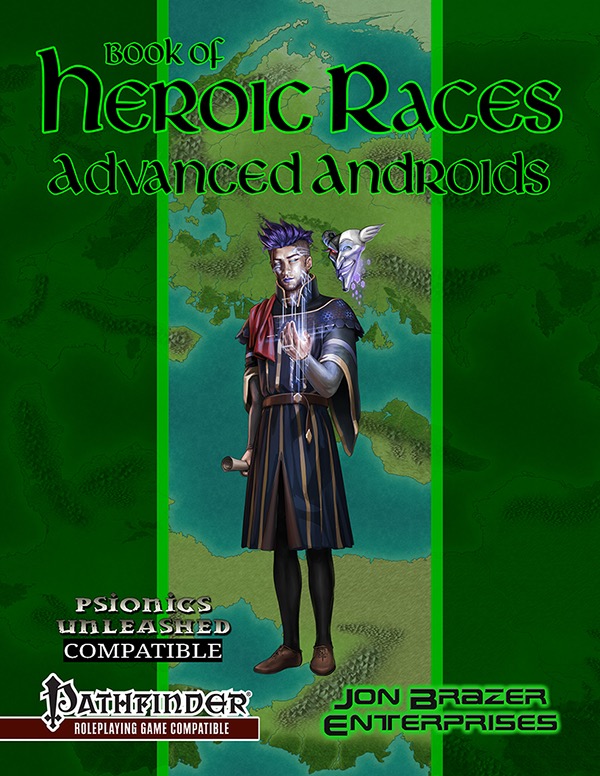
After some fluff we get to a reiteration of the Android racial traits along with some extra alternate racial traits and regular ole traits. The 5 alternate racial traits are pretty good to me. There's a bit of difficulty with the wording on the divine racial trait but they do diversify the Android in terms of flavor. The same can be said for the fluff both before and after the racial traits. Between their entry in Pathfinder Player Companion: People of the Stars and their first appearance androids don't have that much flavor text so this was sorely needed. Beyond that the alternate racial traits opens up doors for classes that are generally hard to use with an android.
As I moved on to the archetypes and class features I noticed that this is the second BoHR I've looked at so far to support Psionics with a Cryptic and Psion archetype. The archetypes themselves are somewhat the highlight of the book for me as they take some classes and really make them a part of the race, more so than a lot of other archetypes that could be tacked on to any race without consequence. Same goes for the racial class features.
From there it's mostly the same as previous Book of Heroic Races. There are new racial feats, a new philosophy (as opposed to deity), spells and psionic powers, another archetype (weirdly in the religion section rather than the racial archetype section.) and android NPCs.
Like the previous BoHR this expands quite a bit but I think a lot of fun was had on the crunch on this one in a way that goes a bit beyond the previous entries I've reviewed so far. That doesn't mean the fluff is lacking either. A lot of space is put into describing how androids work in a world. Overall I think that it's a bit more far reaching and flavorful that the android options in People of the Stars, a book that I was very happy to get so I think this one deserves a full 5 out of 5 stars and I'm putting it on my list of potential favorites for this year.
You can find this product over on Paizo.com here.
In the Infinity Matrix campaign I plan to downplay Paizo classes so I'm a bit unlucky that there is so much to support those classes. But it also supports Psionic classes which I plan to push for the campaign and there is enough that is class agnostic to give it to my players for use. I had my own plans for the fluff of Androids since they were basically summed up as 'of mysterious origins' because they were mostly just lost machine-people found on Golarion, but here there's a lot about how they think and interact with others and each other so I'm definitely making this the baseline for how androids work in addition to adding an actual origin.
Subscribe to:
Posts (Atom)